| 2025 |
Собака Павлова
Fl, Ob, Cl/Bcl, Trn, Perc, Clav, Vn, Vl, Vc, Cb. |
6' | ||
| 2024 |
Ода к ненависти
Монолог для баритона и ансамбля о кольце власти на текст из «Кольца Нибелунга» Вагнера Baritono, Fl (A.Fl, B.Fl.) Bass Clarinet, Bar.Sax, Tromb, 2 Perc., Pno, Harp, Vla, Vc, Cb. премьера: 15.07.2024. Prinzregententheater, Мюнхен Милан Сильянов, баритон Ансамбль Академии Баварской оперы Владимир Юровский, дирижер Мюнхен, Германия COMMENTS (англ.) ПРЕССА
ODE AN DEN HASS / ODE TO HATE Monologue about the Ring of Power on the text from Wagner's Gotterdammerung (2024) The piece was commissioned by the Musical Academy of the Bavarian State Orchestra for the anniversary concert of the ensemble of the Academy. The premiere took place at the Prinzregententheater Munich, a venue designed as a performance space for Wagnerian operas, where the architecture itself is a replica of the Richard-Wagner- Festspielhaus in Bayreuth. The shadow of Wagner, with his great musical ideas and at the same time with his vile anti-Semitism, haunted me from the very beginning of my thoughts on the new piece. Paradoxically, while in Germany Wagner's ideology has long been one of the central targets of devastating criticism, in Russia the name of Wagner became the name of a paramilitary group distinguished by its desire to use fascist symbols. In Wagner's work, perhaps the most striking symbol of hatred is Alberich's monologue from "Gotterdammerung". This monologue is about the thirst for endless personal power over the entire world. From Alberich's expanded text, I chose three key words as a support, a kind of extract of the ideology of any dictator — "Hass" (Hate), "Macht" (Power) and "Ring". These words in my composition play not only an important role as symbols, but also become the phonetic basis of the ensemble texture. Thus, in the words "Hass" and "Macht", the hissing phonemes are imitated by various instruments based on extended techniques, and in the word "Ring", the "r" is imitated by various kinds of flutter tongue toneless and other methods. In a similar way, I worked with other words of the text, aiming to bring the sound of the instruments closer to the spoken language, and to extend the singing technique to the possibilities of the instruments. |
14' | ||
|
Ночь темнее перед рассветом
для бас-кларнета, альта, контрабаса и оркестра 3.2.3.2.-4.2.3.1.-4 perc., Pn, Hf.-3 soloists: Bass Clarinet, Viola, Contrabass – Strings. премьера: 5.05.2024 Филармония на Эльбе, Гамбург, Boglarka Pecze, бас-кларнет, Nils Monkemeyer, альт, Edicson Ruiz, контрабас, Оркестр Гамбургской филармонии Kent Nagano, дирижер Германия ПРЕССА |
38' | |||
| 2023 |
Das alte Jahr vergangen ist:2022 (Старый год ушел: 2022)
Вариации на хорал Баха Версия I: для большого ансамбля барочных и современных инструментов: fl., travers.fl, baroque oboe/modern ob., Cl, Bass cl, Bs.– Hr, Tr, Tn, – 2 Perc, Pn, Hp, –1 modern vn, 2 baroque vn, 1 Alto vla da gamba, 1 Bass vla da gamba, 1 Violone (or Cb); Версия II: для ансамбля 1.1.1.1 B.cl.,1– Hr, Tr, Tn –2 Perc, Pn, Hp - 1.1.1.1.1 премьера: 21 марта 2024 фестиваль «ORA_Bach! Bach alive» Камерный оркестр Mozarteum, дирижёр Simone Fontanelli Моцартеум, Большой зал Зальцбург, Австрия Ансамбль «Студия новой музыки» Дирижер Игорь Дронов Рахманиновский зал, Москва КОММЕНТАРИЙ COMMENTS (English) Das alte Jahr vergangen ist:2022 (Старый год ушел: 2022). Das alte Jahr vergangen ist:2022 (The Old Year Has Passed:2022) |
9' | ||
|
Danse macabre
для оркестра 3.3.3.3.- 4.3.3.1.- 4 perc., pn, hp - 16.14.12.10.8. премьера: 17, 18 ноября 2023 Симфонический оркестр Сан-Диего, дирижёр Rafael Payare, Калифорнийский фестиваль, The Rady Shell at Jacobs Park, Сан-Диего, США КОММЕНТАРИЙ COMMENTS (English) ПРЕССА Danse macabre Danse macabre |
15' | |||
|
Out of Step. Out of Time. March to Stay Still
для клавиш и струн фортепиано Премьера: 3 сентября 2023 Ellen Ugelvik Норвежская Академия Музыки, концерт к 50-летию основания. Осло, Норвегия КОММЕНТАРИЙ COMMENTS (English) Out of Step. Out of Time. March to Stay Still Out of Step. Out of Time. March to Stay Still |
12' | |||
| 2022 |
Опереточная серенада a la España
для меццо-сопрано, флейты, скрипки, виолончели (ударных ad lib.) и фортепиано на стихотворение Гёте «Филина» Премьера: 22 июля 2023 Natalia Skrycka, меццо-сопрано «На изломе времен», мультиарт-проект Kuhlhaus, Берлин |
10' | ||
|
Старая шкатулка из Грузии
для флейты и фортепиано Премьера: 14.04.1923 Manuel Zurria, флейта; Oscar Pizzo, фортепиано Teatro Sperimentale Анкона, Италия |
13' | |||
| 2021 |
Последний закат
для сопрано-саксофона, записи NASA звуков Земли и электроники премьера: 13.10.2021. Юи Сакагоши, сопрано-саксофон Жан Жофруа; Кристоф Лебретон, Light Wall System Рахманиновский зал консерватории им. Чайковского, Москва КОММЕНТАРИЙ Comments (English) Последний закат Владимир Тарнопольский Last Sunset Vladimir Tarnopolski |
13' | ||
| 2020– 2021 |
Тетрадь хоралов для сольных духовых:
Es ist genug, хорал для фагота соло Veni creator spiritus, органум для тромбона соло Judea at Jerusalem для саксофониста, играющего одновременно на двух инструментах |
|||
| 2020 |
Сто дней одиночества для альта соло; версия для скрипки соло Премьера онлайн — 29.06.20 Станислав Малышев, альт Фестиваль «Московская консерватория онлайн» Онлайн–концерт солистов ансамбля «Студия новой музыки» Большой зал консерватории им. Чайковского, Москва |
10' | ||
|
Форсаж для ансамбля 1.1.1.1.1. – 1.1.1.0. – 2perc., 2pn. – 1.1.1.1.1 или: 1.1.2.1 – 1.1.1.0. – 2perc., 1pn – 1.1.1.1.1 Запись на CD первой части пьесы — июнь 2020 Онлайн-премьера первой части пьесы — 9.12.2020 Ensemble Modern, Инго Метцмаxер, дир. Концерт к 40-летнему юбилею ансамбля Большой зал Alte Oper, Франкфурт, Гермaния Премьера пьесы целиком — 12.05.2023 Ensemble Modern Bas Wiegers, дирижер Mozartsaal, Alte Oper Франкфурт, Германия |
8' | |||
| 2018 |
Study of Breath для виолончели соло Премьера: 23.05.2018 Jens Peter Maintz, виолончель Institute for Advanced Study Берлин, Германия КОММЕНТАРИЙ COMMENTS (English)
Study of Breath Владимир Тарнопольский
Study of Breath Vladimir Tarnopolski |
13' | ||
| 2017 |
Be@thoven – Invocation (вслед 4 Концерту Бетховена) для оркестра Премьера: 10.09.2017, Orchestra Radio Hessen (Франкфурт) Дирижер Андрес Ороско-Эстрада BeethovenFest 2017 Concert Hall of the World Conference Center Бонн, Германия Orch: 3.2.3.3.- 4.2.3.1- 5perc. 2pn. 1hp.- 16.14.12.10.8 КОММЕНТАРИЙ КОММЕНТАРИЙ – Видео Kommentar (Deutsch) РЕЦЕНЗИИ и ИНТЕРВЬЮ Видеоинтервью автора перед Московской премьерой Be@thoven – Invocation Владимир Тарнопольский Be@thoven – Invocation Vladimir Tarnopolski |
17' | ||
|
|
||||
|
Perpetuum Moebius для флейты, бас-кларнета, скрипки, виолончели и фортепиано Премьера: 09.03.2017, ансамбль «Пьер Булез» дирижер Даниэль Коэн Недели открытия Концертного зала им. Пьера Булеза Берлин, Германия КОММЕНТАРИЙ Perpetuum Moebius (2017) Владимир Тарнопольский |
8' | |||
|
|
||||
|
Blue Shift (Синее смещение) для оркестра Премьера: 12.01.2017, Мюнхенский филармонический оркестр дирижер Валерий Гергиев Gasteig Kulturzentrum Мюнхен, Германия Оркестр: 5.4.6.4.- 6.3.3.1.- 6 perc., pn, hp, 16. 14. 12. 10. 8 |
20' | |||
| 2016 |
Рассыпанные слова для сопрано и фортепиано по стихотворению Бориса Пастернака «Давай ронять слова» Премьера: 9 июля 2016, Kissinger LiederWerkstatt, Rossini-Saal, Бад-Киссинген, Германия Каролина Мельцер, сопрано; Аксел Бауни, фортепиано ПРЕССА
Борис Пастернак Мой друг, ты спросишь, кто велит,
|
11' | ||
|
| ||||
| 2015 |
Фанфары для фестиваля для трубы и валторны Премьера: 13 октября 2016 фестиваль «Московский форум», Рахманиновский зал Московской консерватории солисты ансамбля «Студия новой музыки» |
1' | ||
|
Портрет девушки с томиком Павезе для сопрано и ансамбля Премьера: 7 октября 2015, La Biennale di Venezia, Ca' Giustinian – Sala delle Colonne ансамбль «Студия новой музыки», Екатерина Кичигина (сопрано), Игорь Дронов (дирижер) Текст: Чезаре Павезе Оркестр: 1.0.1.0 – perc (2) – sopr – pno - 1.1.1.0 «Утро», стихотворение Ч. Павезе
|
13' | |||
|
|
||||
|
Tabula Russia. Закат на Москве-реке для оркестра Премьера: 11 сентября 2015, The Rotterdam Philharmonic Gergiev Festival, Нидерланды Роттердамский филармонический оркестр дирижер — Валерий Гергиев Оркестр: 3.3.3.3. – 3.3.3.1 – 6 perc., pno, harp – 16. 14.12. 10. 8 КОММЕНТАРИЙ РЕЦЕНЗИИ (на голландском и немецком языках) CD: CD–portrait CD: Orchester der Russisch-Deutschen MusikAkademie Tabula Russia (2015) Владимир Тарнопольский |
12' | |||
|
|
||||
| 2013 |
Redshift (Красное смещение) для большого оркестра и электроники Премьера: 1 декабря 2013, Auditorium Rainier III, Монте-Карло, Монако Orchestre Philharmonique De Monte-Carlo дирижер — Dima Slobodeniouk, электроника — Alexis Baskind Оркестр: 2Picc (2.=fl.)3.Fl (3.=picc.), 4., 4., 2Bcl.(2=Cb.cl), 4.(4.=C-bsn) - 6.3.3.1. - 6Perc. - 2 MIDI keyboards, Harp - 16. 14. 12. 10. 8 КОММЕНТАРИЙ Redschift (2013) Владимир Тарнопольский |
18' | ||
|
|
||||
| 2010 |
Last and Lost для камерного ансамбля Премьера: 27 августа 2011, Ferenz Liszt festival, Weimarhalle – Großer Saal, Веймар, Германия Klangforum Wien, Sylvain Cambreling (дир.) Ансамбль: A.fl., B.cl., Perc., Pno, Harp, Vn, Vla, Cello КОММЕНТАРИЙ COMMENTS (English) Klangforum Wien, дирижер Sylvain Camberling Lemanic Modern Ensemble (Швейцария) дирижер Вильям Бланк Last and Lost (2010) Last and Lost (2010) |
11` | ||
|
|
||||
|
К Изольде для флейты соло премьера: Дармштадтские летние курсы 2010 Германия |
4` | |||
| 2008 |
Eastanbul для камерного оркестра Премьера: 11 октября 2008, Alte Oper Frankfurt, Ensemble Modern, cond. Alejo Perez Оркестр: 1.1.2.1. – 2.2.1.0. – 2Perc.- 2Pf(2 also Synth) – 1.1.1.2.1. КОММЕНТАРИЙ COMMENTS (English) Kommentar (Deutsch) |
20` | ||
| 2007 |
Boxing Pushkin сцена из коллективной оперы Сценарий и хореография: Андреа Болл Музыка: Владимир Тарнопольский, Ольга Бочихина, Владимир Горлинский, Алексей Сюмак, Николай Хруст Премьера: 13-19 мая 2007, Арнем, Апельдорн, Наймиген, Амстердам, Гаага (Нидерланды) Солисты: 2Sopr,MSopr, Bar, Bas Оркестр: 2.0.1.0 – 2Sax – 2.2.2.1. ElGuir.BGuit- 3Perc.- Pf.Synth.Bayan – 2.1.1.1. |
≈ 70` |
||
| 2006 |
Jenseits der Schatten (По ту сторону тени) мультимедиа-опера Сценарий: Владимир Тарнопольский по мотивам «Притчи о пещере» Платона Текст: Данте, Леонардо, Ницше. Компиляция и дополнительные фрагменты – Ральф Гюнтер Моннау Костюмы и сценография: Бабис Панагиотидис Видео и спецэффекты: Фридер Вайс Премьера: 20 сентября 2006, Beethovenfest. Kunst- und Ausstellunghalle, Боннская опера, Palindrome Dance Company, ансамбль MusikFabrik, дирижер – Вольфганг Лишке, постановка – Роберт Векслер. Солисты: 2Sopr,MSopr, Ten, Bar, Bas. Ансамбль 1 (right): 1.1.1.0 – 1.0.0.0.- 2Perc.- Pf(=Synth.) – 1.1.1.0. Ансамбль 2 (left): 1.0.1.0 – Sax – 0.0.1.0.- 1Perc.- Hp – 1.1.1.1. КОММЕНТАРИЙ (рус.) КОММЕНТАРИЙ (англ.) ФОТОГРАФИИ с премьеры ВИДЕОЗАПИСЬ премьеры на Бетховенском фестивале. Бонн 2006: Видеофрагменты РЕЦЕНЗИИ (нем., рус. яз.) Jenseits der Schatten The impulses for the creating of this scenario came from two ancient sources — the «Cave Allegory» by Plato and the story about the Origin of Painting from Shadow by Plinius the Elder. Both these stories are based on different interpretations of the phenomenon of Shadow. For Plato the shadow is a sign of the Eidos (the idée) and for Plinius the shadow is a prototype of the Painting. In my scenario I unite these two ideas and develop them in theirs interconnection in another form. Contrary to Plato in the scenario just the Art unbind the prisoner from the cave. And contrary to Plinius the shadow is something much more significant than only an optic phenomenon. The Shadow in the opera comes out of collision between Light and Dark. The composition of the opera is based on parallel development of two blocks. The first block represents the Allegories of Arts. It is visualized by 3 sopranos and the female-dancer. The second block represents the Prisoners in the cave. It is vizualized by male trio and the male dancer. Only one of the Prisoners — the Dancer — finds the way to the Light at the end of the opera. The fragments from the texts by Dante («Divine Comedy», male trio), Leonardo («The Disput of the Arts», female trio), Nietzsche («Jenseits von Gut und Bose») are used in the opera. The compilation of the texts as well as several additional fragments were set up by Ralph Günther Mohnnau. |
≈ 65` |
||
| 2004 |
Маятник Фуко для камерного оркестра Премьера: 11 ноября 2004, Concertgebouw, Main Hall, Amsterdam, Schönberg Ensemble, дирижер – Reinbert de Leeuw Оркестр: 2.1.1.BCl.Sax.1 – 1.1.1.0 – 2Perc – Pno,Hp,Cymb,Guit – Bayan,Acc – 1.1.1.1.1 КОММЕНТАРИЙ МАЯТНИК ФУКО Владимир Тарнопольский CD: MSCCD 0224 |
25' |
||
|
|
||||
| 2003 |
Блуждающие огни для оркестра Премьера: 8 декабря 2003, Cité de la Musique, Paris, Ensemble Intercontemporain, дирижер – Владимир Юровский Оркестр: 3.2.2.Bcl.2.– 2.2.2.1 –3Perc., Pn, Hp – Strings КОММЕНТАРИЙ COMMENTS (English) Feux follets for orchestra (2003) Vladimir Tarnopolski Блуждающие огни для оркестра (2003) Владимир Тарнопольский |
10' |
||
|
Правдивая история Золушки Музыкальная сказка для взрослых в сопровождении детей. Для чтецов, детского хора, детского оркестра (любого состава) и камерного ансамбля Текст: Роальд Дал Премьера: 28 апреля 2003, Barbican hall, London, Centre for Young Musicians orchestra and London Schools Symphony orchestra, дирижер – Peter Ash Детский оркестр: флексибанд (любые духовые инструменты – 4 партии), 5 солистов-ударников, ансамбль ударных, арфа, фортепиано, струнные Детский хор 6 чтецов Ансамбль: 1.1.1.BCl.1. – 1.1.1.0. – 2Perc – Hp – 1.1.1.1.1. КОММЕНТАРИЙ РЕЦЕНЗИИ (рус., англ. яз.) ФОТОГРАФИИ с премьеры ПРАВДИВАЯ ИСТОРИЯ ЗОЛУШКИ |
60' |
|||
| 2001 |
Чевенгур для сопрано и камерного ансамбля Текст: Андрей Платонов Премьера: 4 сентября 2001, Paradiso, Amsterdam, «Студия новой музыки», Светлана Савенко, дирижер – Игорь Дронов Ансамбль: 1(=BFl).0.1.BCl.0. – 0.0.1.0. – Perc – Bayan – Tape – M-Sopr – 1.0.1.1.1. Наталия Пшеничникова, меццо-сопрано Студия новой музыки, дирижер Владимир Горлинский 26 июля 2010. Дармштадт, Германия Александра Любчанская, меццо-сопрано Ансамбль «Желтый звук», дирижер Владимир Юровский 17 декабря 2023, Мюнхен Комментарий Владимира Тарнопольского: КОММЕНТАРИЙ И ТЕКСТ Comments (англ.) Kommentar und Text (нем.)
CHEVENGUR for soprano and ensemble (2001) ПРЕССА |
13' |
||
|
|
||||
| 1999 |
Когда время выходит из берегов (Три времени-сестры) Анатомия меланхолии опера в 3-х сценах Текст: Ральф Гюнтер Монау по мотивам Антона Чехова Премьера: 27 апреля 1999, Münchener Biennale, Staatstheater am Gärtnerplatz, дирижер – Ekkehard Klemm Солисты: 2Sopr,MSopr, CTen, Ten, Bar, Bas. Оркестр: 2(I=Picc,II=Picc,=AFl).1.1.BCl.1 – ASax, BarSax – 1.1.1.1.- 3Perc.- Pf(=Synth.)Hf – Guit.EGuit.BGuit –Soli:Vn.Vl.Vc – 5.0.3.3.1. Фото и комментарии Pictures and Comments (English) Foto und Kommentar (Deutsch) Рецензии (рус., нем. яз.) Видеофрагменты (4) Wenn die Zeit uber die Ufer tritt My opera "When Time Overflows…" was written in 1999 as a commission for the the festival of contemporary music theater – Münchener Biennale. The opera is based on separate situations and motives of the well-known Chekhov pieces – "Three Sisters", "Seagull", "Uncle Vanya" and others. However, the libretto does not simply follow these pieces but creates a certain new METATEXT, like a commentary on Chekov. At the same time, the impulse for the development is not the plot, which would be typical for a so-called literary opera, but a principle of confrontation of the same party situation in the three scenes of the opera. In the first scene the action happens in a Russian province during the time of Chekhov (at the turn of the XX century); the second scene takes place in our times, in a certain cultural center at the turn of the millennium; and in the third one we find ourselves in an indefinite future, in a certain virtual space. According to the three different times (past– present – future) and three different mentalities (a Russian province – a world capital – an "above-the-planetness"), the topics of the talks change: from love (1st scene) — to art (2nd scene), and, finally— to death (3rd scene). For all the external contrasts of the entourage it turns out that the existential problems of man appear to be the same in all times, namely — the impossibility of communication and of mutual understanding, the persistence of loneliness and the absence of a sense of meaning in life. These problems can never be solved, but are redoubled during the course of the development of our civilization. This immutability is reflected in a particular aspect of the construction of the opera in which the three scenes represent three free variations with a recurring structure. At the beginning of each scene there is the same text. "Today is Sunday" – an episode of the three sisters, who nostalgically dream about something. Then two male characters appear and introduce the major theme of the scene: love, art or death. Finally, after the ostinato culminations, two more characters – a bass and a counter-tenor – switch the "lofty" talks in a slightly parodic-grotesque context. Each scene finishes with an episode of the "clock", inexorably counting time, and the title cue of the opera "When Time Overflows its Margins". With this construction, I wanted to communicate one of the central existential ideas of Chekhov – that people do not change; only objects change. Such a construction, which is based on a principle of three, connects with a special understanding of a temporal phenomenon. Time is not a vector here (there is practically no action in the opera), but a kind of annual ring, each of which is a variant of a previous one. Along with immutability, there also functions an opposite principle of progressive deconstruction in the opera, applying to the quality of sound texture. Thus, as the opera progresses, the instruments more and more often use different "non-classical," "estranging" devices of sound producing: multiphony with the winds, half-sounds with the strings and many others. In the most obvious way this deconstruction is shown in the evolution of the only leitmotiv of the opera - the motive of time. Emerging from sudden rustles, it gains a bell-like character in the first scene, and then it loses its determinacy more and more, dissolving in glissandos and turning to gnashings and clusters. No less radically, the principle of deconstruction is shown in the evolution of the vocal line: if a complicated cantilena prevails in the first scene, then in the second one Sprechstimme, singing of consonants, and the fragmentation of the text play more important role. Finally, in the third scene, the words themselves deconstruct into their separate sounds, which are distributed between the characters. A type of vocal line in some episodes is written graphically: a vibrato turns to a choking tone and other non-classical kinds of singing. All the three scenes contain many quaint details from Chekhov's epoch, all of which are present and "active", though often also by detached and unexpected means, transgressing their classical functions: the usual shot-gun, well-known from Checkhov's stories, actually shoots here and even twice, the piano turns out to be a mechanical one, the clock with chimes, the striking of which marks the division between the scenes, suddenly indicates in a loud volume the real time in the real performance. The individual descriptions of the characters, which still can be guessed in the first scene, are also under deconstruction later on: the characters gradually lose even their names (in the second scene they are marked only with the first letters of their names, and in the third one— with neutral numbers). The absence of true characters leads to the impossibility of including any solo arias in the structure of the opera; that's why the composition is the opera-ensemble. The principle of ensemble became a clue for me in my work: three sisters sing all together, they represent a certain triple-unity. In addition, number 3 is another important organizing moment of the opera. The three sisters are accompanied by the solo string trio. Three themes (love-art-death) determine the content of three scenes, which embody three times and three places. In the three culminations, Latin words sound three times when the characters scan the key words in each of the scenes. That is, the idea of Latin I drew from fleeting details form Chekov's Masha (Three Sisters) who in anger at her husband conjugated the Latin verb 'to love' — amo. From this seed I tried to grow a tree determining the sense and construction of the entire opera. This example illustrates well my approach to Chekov's text. I am absolutely not attempting to approach the so-called "genuine", but in any case I don't think that this is possible in opera. On the contrary, I completely refuse the naive idea of setting to music the text of Chekov. I am convinced that the modalities and languages of art are non-translatable from one to another, and even the simplest dramatization of any play on the theatrical stage forces the director to qualitatively rethink and restructure all of the material. When we speak about an opera, howerer the composer is simply obliged to find a completely new code, a new construction and a new style to the material. In this way, the most important problem for me appeared to be the fusion of various types of stylistic elements, but not in the banal polystylisticism a la Schnittke which brings together in only essence the sum of stylisation and citation, but in depth, at the level of 'sound-genetics'. I have tried to find some kind of metastyle in the sonoric magma which one way or another would wash away any potential certainty by means of sonoric waves of harmony-timbre-noise. For myself. I characterise this as a new euphony (a new harmony) in which is counterposed consonance and dissonance, sound and noise, harmony and timbre, acoustic and electronic instruments. In the opera, I often returned to the scarcely perceptible stylistic allusions which change their contours like a chameleon. I "recalled" in music frozen moments of Glinka, cards of Tchaikovsky, chimes of Mussorgsky, endless cantilenas of Rachmaninov, and the shrill anguish of Lady Macbeth, although of course, the listener of these allusions will not be aware of this. In the first scene, I even cited a phrase of Liebestraum of Liszt, and at the culmination of the opera used elements of rap and minimalism. By way of development these idioms aquired a palpable critical accent and in the end destroyed themselves under the weight of their own characteristics. However I tried to articulate this whole stylistic spectrum not on the level of a superficial comparison but through a root system sprouting through the sound fabric. Today, at the threshold of the 21st Century, there are no "good" and "bad" media. All depends on how the employed means address the given individual conceptions of a given concrete composition; on how interesting is the given individual idea. So with this opera, I tried, not breaking from the principle precepts of the opera genre to find more freedom in the creation of new ideas. In the last scene, the librettist includes the death address to humankind communicated by the members of the suicidal religious sect "Temple of the Sun", who poisoned themselves en masse. This unexpected, and perhaps shocking idea in the context of Chekov, seems to be in my view a very organic one for the opera: the text of the address has deep and unexpected, almost literal deep parallels with some of the maxims of Chekhov's characters. It encloses the ring of the opera's plot and marks the "timeless" archetypical nature of the age-old problem of our short existence, as discovered by the genius of Chekhov. |
≈ 90` | ||
| 1998 |
В театр Dance-, Word-, Light-, Music-Play Текст: Эрнст Яндль Премьера: 15 июня 1998, International Theaterschool Festival, Amsterdam, Orchestra de Ereprijs 3 вокальные группы: детская, женская, мужская Оркестр: 1(=picc).0.0.BCl.0. — ASax, BarSax. – 2.1.2.1. — 1(2)Perc – 3 Tapes– Pf (=Synth)– EGuit, BGuit |
17' |
||
| 1996 |
…Ветер слов, которые он не успел сказать для виолончели с оркестром Оркестр: 3(II, III=Picc).3.3(III=Picc).BCl. 3. – 4.2.2.0. – 2Perc – Hp – 0.0.8.6.4. Премьера — 1996 г., Концертная студия Польского радио. Julius Berger, виолончель (Германия), оркестр Sinfonia Varsovia, дирижер Wojciech Michniewski. Российская премьера — 21 ноября 2006 г., Большой зал Московской консерватории, Концерт-закрытие VII фестиваля «Посвящение Олегу Кагану». Исполнители — Наталья Гутман, Государственный симфонический оркестр «Новая Россия», дирижер Юрий Башмет. КОММЕНТАРИЙ COMMENTS (English)
Le vent des mots qu'il n'a pas dits Владимир Тарнопольский
Le vent des mots qu'il n'a pas dits Vladimir Tarnopolski |
15' |
||
|
|
||||
| 1995 |
Пейзаж после битвы на тексты из Дуинских элегий Райнера Марии Рильке для большого ансамбля, баритона и мужского хора (ad lib) Премьера:6 мая 1995, Франкфурт, Ensemble Modern, Nicolas Isherwood, дирижер – Friedrich Goldmann Ансамбль: 1(=AFl).1(=EHrn).1(=Picc).BCl.(=CbCl).1. – 1.1.1.0. – 2Perc –Hp, Pf – Tape – 1.1.1.1.1. Издательство: C.F.Peters КОММЕНТАРИЙ (нем.)
Landschalt nach der Schlacht
für ensemble und bass nach Lekture der Duineser Elegien von R.M.Rilke (1995) Das poetische Bild des Titels greift ein Motiv in der Kunst der letzten Zeit auf: die Idee des Nachworts, des Postscriptums. Indem das Werk Tarnopolskis die Reihe von Werken ahnlichen Charakters (ort-setzt, bildet es zugleich einen Ruckblick auf diese Idee: die Landschaft einer verwusteten, verlassenen Welt wird durch Rilkes poetische Bilder in ein erhabenes Panorama des Weltgeschehens verwandelt. Rilkes Duineser Elegien stellen eine Reaktion des Dichters auf die Ereignisse des Ersten Weltkriegs dar. Ihre schreckliche, monumentale und zugleich zitternd verschwommene, aus winzigen Details gewobene Welt gibt bizarre Kriegserfahrungen wieder. Ein uberwaltigendes Bild der Kosmogonie mit tragischen Kollissionen und Kataklismen des Seins entsteht. Der grosse Weltrhythmus erscheint im standigen Werden und Untergehen. Diese widerspruchlich-zerrissene Einheitlichkeit der Welt birgt den Begriff des Schonen in sich. Die Idee des Ubergangs der Schonheit in ihren Gegensatz bildet den Hauptinhalt des Werkes von Tarnopolski, was in erster Linie durch klangfarblich-instrumentale Mittel wiedergegeben wird. Aufgrund einer detailliert durchgearbeiteten Skala der Tonschwebungen werden naturliche Klangfarben verfremdet, originale Tone mutiert und klangfarbliche Ubergange erreicht. Das Werk ist dem Ensemble Modern gewidmet. Rainer Maria Rilke «Duineser Elegien» (1912-1922) aus: «Die erste Elegie» Wer, wenn ich schriee, horte mich denn aus der Engel Ordnungen? /.../ ich verginge von seinem starkeren Dasein. Denn das Schone ist nichts als des Schrecklichen Anfang, den wir noch grade ertragen, und wir bewundem es so, weil es gelassen verschmaht uns zu zerstoren. /…/ aus: «Die dritte Elegie» Eines ist, die Geliebte zu singen. Ein anderes, wehe, jenen verborgenen schuldigen Fluß-Gott des Bluts. /…/ O des Blutes Neptun, o sein furchtbarer Dreizack. O der dunkele Wind seiner Brust aus gewundener Muschel. /…/ |
25' |
||
|
Сцены из настоящей жизни для сопрано, флейты, валторны и фортепиано Текст: Эрнст Яндль I. My Own Song. II. Inhalt. III. Chanson. IV. Ins Theater Премьера: 8 сентября 1995, Berliner Festwochen, Ensemble Modern, сопрано – Susan Narucki КОММЕНТАРИЙ и ТЕКСТ ПРЕССА Статья О.Бочихиной |
20' |
|||
| 1994 |
Дыхание исчерпанного времени Премьера: 9 May 1994, Gasteig, München, Symphonieorchester des Bayerischen Rundfunk, cond. – Alexander Lazarev 4(II, III=Picc, IV=alto).3(III=EHrn).3.2BCl.3(III=CBsn). – 6.2.4.1. – 6Perc – Hp, 2 Synth(II=Pf) – 2 EGuit – 14.12.10.10.8. Edition: C.F.Peters КОММЕНТАРИЙ COMMENTS (англ.) РЕЦЕНЗИИ
Дыхание исчерпанного времени Владимир Тарнопольский
The Breath of the Exhausted Time Vladimir Tarnopolski |
24' | ||
|
|
||||
| 1993 |
Ох, эти русские… или Волшебный напиток
Музыкальный фарс Текст: Ирина Масленникова Премьера:27-28 мая 1993, Rencontres Musicales d'Evian, «Студия новой музыки», дирижер – Мстислав Ростропович Солисты: 3 Sopr, 3 MSopr, 1 CAlt, 3 Ten, 3 Bar, 1 Bass Оркестр I: 1(=Picc).1(=ASax).1(=Picc,=SSax).BCl(=ASax).Bsn(=CBsn). – 2.1.1.1. – 2Perc – Pf(=Cemb,=Cel) — 1.1.1.1.1. Оркестр II (струнные): 4.4.2.2.0. |
45' |
||
|
Полный безумия мир для большого ансамбля Текст: Курт Швиттерс I. Welt voll Irrsinn. II. Zwölf. III. Banalitäten aus dem Chinesischen. Премьера: 12 июня 1993, Амстердам, оркестр «de Ereprijs» Оркестр: 1(=Picc).0.1(=BCl).0. — ASax,BarSax(=SSax) – 2.1.2.1. — 1Perc – Tape – Pf (=Synth)– EGuit, BGuit Издательство: C.F. Peters CD: KLIMOP 006 ТЕКСТ(нем.) и КОММЕНТАРИЙ (англ.) |
15' | |||
|
|
||||
| 1992 |
O, PÄRT – OP ART инсталляция трезвучия для кларнета, скрипки, альта, виолончели и фортепиано Премьера: 8 декабря 1992, Концертный зал им.П.И.Чайковского (Москва), Moscow-Modern Festival Издательство: C.F.Peters |
10' | ||
|
Amoretto для сопрано, 2 кларнетов (II=BCl), альта, виолончели и контрабаса Текст: Эдмунд Спенсер Премьера: 17 августа 1992, Дартингтон (Великобритания), Composers Ensemble, сопрано – Mary Wiegold |
7' |
|||
| 1991 |
Кассандра для большого ансамбля Премьера: 8 сентября 1991, Alte Oper, Frankfurt-Feste, Ensemble Modern, дирижер – Ingo Metzmacher 1.1.2(II=BCl).1(=CBsn). – 1.1.1.1. – 2Perc – Pf, Synth, Hp – 1.1.1.1.1. Издательство: C.F.Peters CD: MEGADISC MDC 7838, Klangfarben Boswil 14 КОММЕНТАРИЙ Comments (English)
КАССАНДРА Владимир Тарнопольский
CASSANDRA Владимир Тарнопольский |
23' |
||
|
Ансамбль «Студия новой музыки» (Москва), дирижер Игорь Дронов |
||||
| 1990 |
Per archi памяти Луиджи Ноно для квартета ударных Премьера: 12 апреля 1991, Концертны зал им.П.И.Чайковского (Москва), Ансамбль Марка Пекарского |
10' |
||
|
Отзвуки ушедшего дня
Трио для кларнета, виолончели и фортепиано Премьера: 26 ноября 1990, Huddersfield Contemporary Music Festival, Chameleon Ensemble КОММЕНТАРИЙ COMMENTS (English)
ОТЗВУКИ УШЕДШЕГО ДНЯ Владимир Тарнопольский
ECHOES OF THE PASSING DAYS СТАТЬИ |
18' |
|||
|
Олег Танцов, кларнет; Наталия Савинова, виолончель; Виктор Ямпольский, фортепиано Никита Агафонов, кларнет; Ольга Галочкина, виолончель; Мона Хаба, фортепиано |
||||
| 1989 |
Eindruck-Ausdruck. Hommage a Kandinsky (Impression-Expression) I версия: для фортепиано Премьера: 18 ноября 1989, Aktive Musik Festival, Dortmund, Tatjana Porwoll Михаил Дубов, фортепиано II версия: для фортепиано и большого ансамбля (1992) 1.1.2(II=BCl).1. – 1.1.1.0. – 2Perc – Hp, Pf solo – 1.1.1.1.1. CD: MEGADISC MDC 7838 Премьера: 19 февраля 1993, Radio France, Paris, Московский ансамбль современной музыки, фортепиано – Владимир Ямпольский III версия: для фортепиано, флейты, кларнета и струнного трио (1996) Премьера: 2 октября 1996, Gesteig, München, фортепиано – Siegfried Mauser Ensemble Assonance Narek Avagyan – флейта, Arsen Grigoryan – кларнет, Ani Karapetyan – скрипка, Mary Dolmazyan – альт, Mikayel Navasardyan – виолончель, Anahit Dilbaryan – фортепиано дирижер Artur Akshelyan 17.02.2019, Komitas Chamber Music Hall Ереван, Армения КОММЕНТАРИЙ СТАТЬИ
EINDRUCK-AUSDRUCK |
12' | ||
|
Троïсти музики фортепианное трио с пением Текст: Григорий Сковорода – Гимн нищете Христовой Премьера: 11 октября 1989, фестиваль «Альтернатива», Москва |
23' | |||
|
По прочтении музыкальных набросков Мусоргского Концерт для хора, солистов, чтеца и камерного оркестра Премьера: 19 апреля 1989, Музыкальный театра Покровского, Москва, дирижер – Геннадий Рождественский Солисты: M-Sopr, Bar Хор: 5.5.5.5. Оркестр:1.1.1.1(=BCl).1. – 2.1.1.0. – 2 Perc – Strings |
25' |
|||
| 1988 |
Бруклинский мост, или Мое открытие Америки Кантата для сопрано, тенора и оркестра (или большого ансамбля) Текст: Владимир Маяковский I. Brooklyn Bridge. II. Prohibition. III. The Horns instead of Bells. IV. American Russians I версия (для оркестра): 1.1.1.BCl.1. – SSax, 2ASax – 2.1.1.1. – 3Perc – Hp, Pf, Balalayka (ad lib.), Bayan – Sopr, Ten – Strings Премьера: 10 ноября 1989, San Diego Symphony Orchestra, дирижер – Василий Синайский II версия (для большого ансамбля): 1.1(=ASax).1(=SSax).BCl(=ASax).1. – 2.1.1.1(ad lib.). – 2 Perc – Hp, Pf, Balalayka (ad lib.), Bayan – Sopr, Ten – 1.1.1.1.1. Премьера: 4 июня 1989, Almeida Festival Music, London, Ансамбль солистов Большого театра, дирижер – Александр Лазарев КОММЕНТАРИИ (англ.)
BROOKLYN BRIDGE
|
17' | ||
| 1987 |
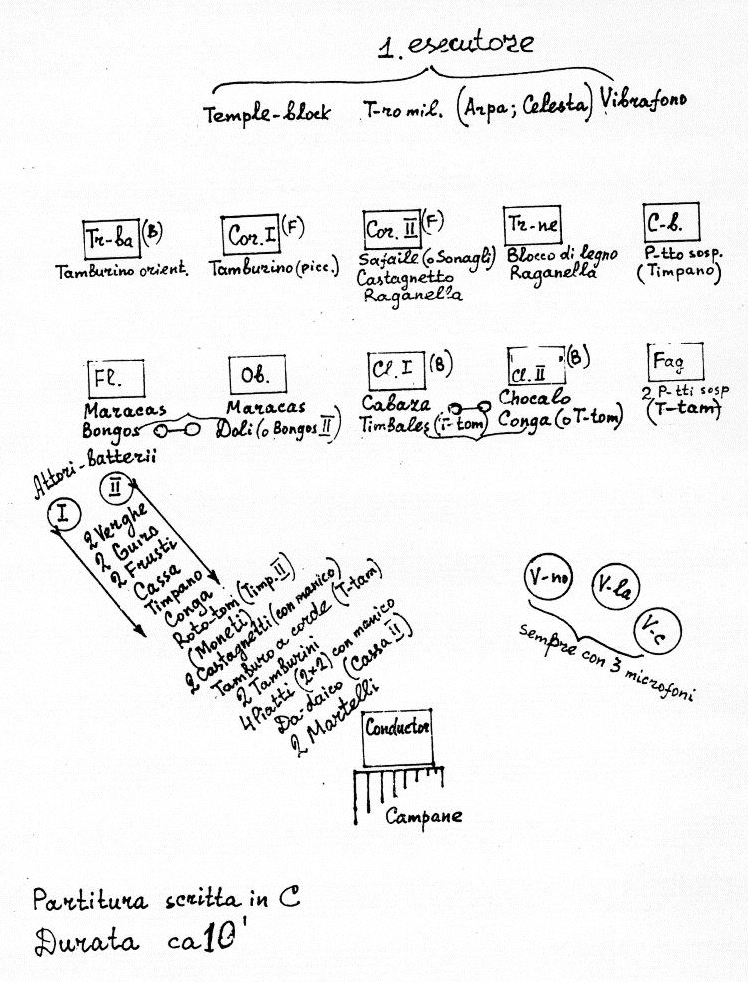
Хоральная прелюдия «Иисус, твои глубокие раны» для струнного трио, ударных и ансамбля Премьера: 18 апреля 1987, ГАБТ, Москва, Ансамбль солистов Большого театра, дирижер – Александр Лазарев Ансамбль: 1.1.2.1. — 2.1.1.0. — 3Perc – 1.0.1.1.1. Схема диспозиции инструментов КОММЕНТАРИЙ Comments
Хоральная прелюдия «Иисус, твои глубокие раны» (1987)
Choral Prelude Jesu, deine tiefen Wunden (Jesus, your deep wounds), Instrumental
theatre for 2 percussionists, string trio and ensemble (1987) was inspired by Dürer's
engravings "Passions" and is based on the melody of the 16th century Protestant chorale.
The idea of commenting the chorale’s text by musical means, traditional for the genre of
the chorale prelude, receives here a theatrical manifestation, as well — during the course
of the entire composition, two solo percussionists slowly move towards the direction of
the conductor along a long array of percussion instruments, depicting flogging by their
bodily motions during the performance. The objects of sound production here are not only
the traditional orchestral percussion instruments, but also rods, strikes on drawn-out
palms of hands (“slaps in the face”), the clinking of 30 coins and strikes of hammers. The
object of the flogging turns out to be the conductor himself, who freezes at the end of the
piece in the pose of a crucifixion. This naturalistic picture in the vein of Dürer comprises
the composition’s first stratum.
CD: MEGADISC MDC 7838 |
10' | ||
|
Три грации
Опера-пародия в трех сценах Текст: Карл Мария фон Вебер Премьера: 30 апреля 1988, Большой зал Ленинградской филармонии им. Д.Д. Шостаковича, оркестр и хор Министерства культуры СССР, дирижер – Геннадий Рождественский Солисты: Sopr, MSopr, Ten, Bar, Bass, Narr Хор: 4.4.3.3. Оркестр:1(=Picc).1.1(=Picc).1(=CBsn). – 4(or 2).0.0.0. – 1(or2)Perc – Cemb, Hp – 6.4.3.3.1. Издательство: C.F.Peters |
45' |
|||
| 1986 |
Покаянный псалом (Psalmus poenitentialis) Концерт для хора, солирующей скрипки, органа и ударных Текст: Псалм 31 Премьера: 6 мая 1990, Schola Cantorum of Oxford, Лондон КОММЕНТАРИЙ (рус.) КОММЕНТАРИЙ (англ.)
PSALMUS POENITENTIALIS (Ps.31). (Покаянный псалом)
PSALMUS POENITENTIALIS (Ps.31). (Psalm of Repentance) |
28' | ||
| 1984 |
Wahnfried для скрипки соло, фортепиано, 6 вагнеровских туб (или 5 тромбонов и тубы), 5 траверс-флейт (или флейт и кларнетов) и хора (или записи) Текст: Рихард Вагнер Премьера: 4 мая 1991, Большой зал Московской консерватории им.П.И.Чайковского, оркестр и хор Министерства культуры СССР, дирижер – Геннадий Рождественский |
9' | ||
| 1983 |
Музыка памяти Дмитрия Шостаковича Коллаж для чтеца и камерного оркестра Текст: Анна Ахматова, Михаил Матуссовский, Александр Межиров, Джэймс Паттерсон Премьера: 12 января 1985, Москва, оркестр Министерства культуры СССР, дирижер – Геннадий Рождественский 1(=Picc,=AFl).1(=EHrn).2(I=Picc,II=BCl).1(=CBsn). – 2.1.0.0. – 3Perc — Pf(=Cel) – Tape – Narrator –12.0.6.6.4. |
17' | ||
| 1982 |
Симфония
Премьера: 26 ноября 1983, Большой зал Московской консерватории имени П.И. Чайковского, дирижер – Игорь Чалышев 3(II=Picc).3.3(II=Picc,III=BCl).3(III=CBsn). — 4.3.3.1. — 3Perc — Pf, Hp — 16.14.12.10.8. |
30' | ||
| 1980 |
Концерт для виолончели с оркестром Премьера: 21 декабря 1982, Большой зал Московской консерватории им. П.И. Чайковского, Симфонический оркестр Министерства культуры, солист Сергей Судзиловский, дирижер Геннадий Рождественский 3(II=Picc).2.CorA.3(III=BCl).3(III=DBn) – 4.3.3.1. – 2Perc — Pft(Cel), Hp — Vlc solo.– 14.12.10.8.6. Издательство: Советский композитор |
20' | ||
| 1978 |
Симфонический пролог для оркестра Премьера 26 ноября 1978, Большой зал Московской консерватории им.П.И.Чайковского, дирижер – Владимир Кожухарь 3(II=Picc).3.3(II=Picc, III=BCl).3(III=CBsn). — 4.3.3.1. — 3Perc — Pf, Hp — 16.14.12.10.8. |
15' |
||
| 1977 |
Струнное трио Премьера: 7 июня 1978, Малый зал Московской консерватории им.П.И.Чайковского |
15' |
||
| 1976 |
Итальянские песни для сопрано и фортепиано Текст: Александр Блок |
10' |
||
|
Kammerharmonie для арфы, виолончели и контрабаса |
10' |
|||
| 1975 |
Квинтет для флейты, гобоя, кларнета, фагота и валторны |
10' |
||
| 1974 |
Hommage a Joan Miro для арфы |
5' |
||
|
Моменты для фортепиано |
10' |
|||
| 1973 |
Карпатские вариации I версия: для фортепиано II версия: для камерного ансамбля (1.1.1.1. – 1.0.0.0. – Hp – Strings) |
8' |
||
|
Свирель запела для сопрано, флейты, альта и арфы Текст: Александр Блок |
15' |
|||
| 1972 |
Партита I версия: для фортепиано II версия: для органа |
10' |
||